- Researchers at the IIBM have demonstrated that vestibular schwannoma cells exhibit spontaneous cellular senescence, a state that influences their response to experimental therapeutic strategies and provides new insights into the biology of these tumors. The study has been published in Neuro-Oncology Advances
The Neurobiology of Hearing and Myelinopathies group, led by Prof. Isabel Varela-Nieto at the Instituto de Investigaciones Biomédicas Sols-Morreale (IIBM), CSIC-UAM, in collaboration with the “Research in Otorhinolaryngology and Head and Neck Surgery” group led by Dr. Luis Lassaletta of the Instituto de Investigación Sanitaria del Hospital Universitario La Paz (IdiPAZ), have investigated the role of cellular senescence in the pathobiology of vestibular schwannoma.
Vestibular schwannomas are benign tumors that arise from Schwann cells surrounding the vestibulocochlear nerve, which is responsible for hearing and balance. Although these tumors generally grow slowly, they can cause hearing loss, tinnitus, balance disorders and, in some cases, compression of adjacent neural structures. Despite their clinical impact, the molecular mechanisms underlying their development and biological behaviour remain poorly understood. Cellular senescence is a cellular response to different types of stress that leads to a stable proliferative arrest while cells remain metabolically active and influence their surrounding environment through the secretion of signalling molecules.
The study demonstrates that vestibular schwannomas accumulate senescent cells spontaneously, a feature that is absent in healthy peripheral nerves. Furthermore, the researchers identified increased expression of characteristic senescence markers in primary vestibular schwannoma cultures, including the protein p16 and several components of the senescence-associated secretory phenotype (SASP), confirming that senescence is a relevant biological feature of these tumors. The results also revealed marked heterogeneity among primary tumor cultures. Tumors with lower baseline levels of senescence responded more efficiently to treatments designed to induce this cellular state and could subsequently be eliminated by combining these treatments with a senolytic drug that selectively induces the death of senescent cells. In contrast, tumors displaying higher levels of spontaneous senescence showed a reduced response, associated with alterations in the p53/p21 signalling pathway, one of the main regulators of the cellular response to DNA damage.
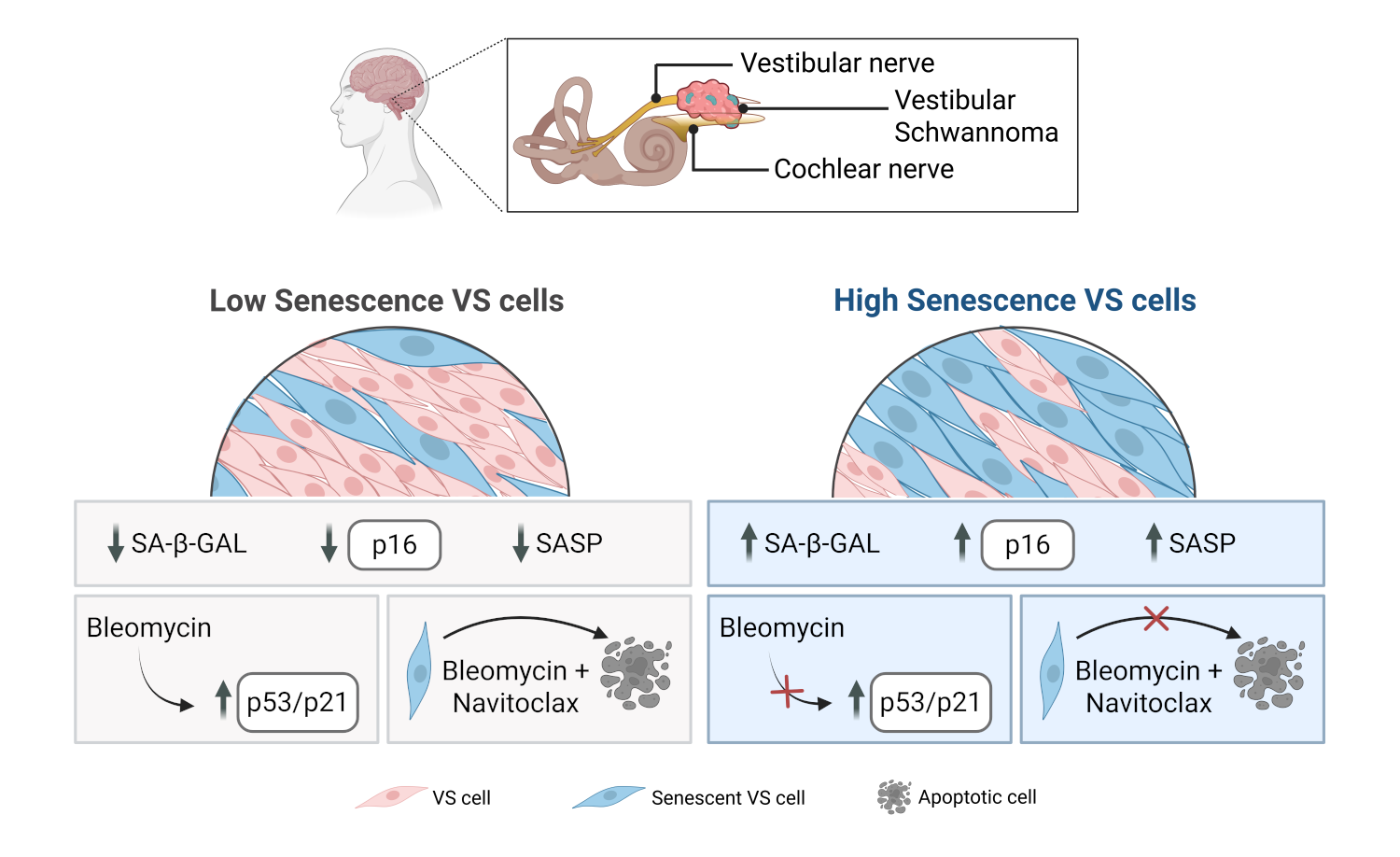
Graphical summary of the intrinsic heterogeneity of primary cultures derived from human vestibular schwannoma cells.
These findings demonstrate that the senescent state of tumor cells plays a critical role in determining their response to cellular stress and to potential therapeutic interventions. The study provides new insights into the biology of vestibular schwannomas and lays the groundwork for future research aimed at developing personalized therapeutic strategies based on the modulation of cellular senescence.
The study, entitled "Spontaneous Cellular Senescence and Stress Response Heterogeneity in Human Vestibular Schwannomas”, was led by Sandra Franco-Caspueñas as first author, with Dr. Ana M. Jiménez-Lara and Prof. Isabel Varela-Nieto as senior authors. The work involved researchers from the IIBM, the Centre for Biomedical Network Research on Rare Diseases (CIBERER), and IdiPAZ.
Article reference: Franco-Caspueñas, S., Ruiz-García, C., Contreras, J., Iturrate, A., la Rosa, L. R., Lassaletta, L., Varela-Nieto, I., & Jiménez-Lara, A. M. (2026). Spontaneous cellular senescence and stress response heterogeneity in human vestibular schwannomas. Neuro-oncology advances. https://doi.org/10.1093/noajnl/vdag190
Cover photo: Human vestibular schwannoma cells in culture. Cyan indicates the nucleus; yellow indicates actin filaments, showing cell morphology; magenta indicates the Schwann cell lineage marker S100B.