- A team led by Dr. Margarita Díaz-Guerra at the IIBM has identified a new mechanism involved in ischemic stroke which depends on TrkB-T1 receptor processing and paves the way for developing new therapies to treat stroke and other acute injuries affecting the central nervous system
The research group Protective peptides against acute and chronic injury of the nervous system led by Dr. Margarita Díaz-Guerra at Institute for Biomedical Research Sols-Morreale (CSIC-UAM), has published key findings advancing the understanding of ischemic stroke in the journal Molecular Biomedicine. The study unveils a crucial mechanism regulating neuronal damage and glial cells activation in the brain after stroke; furthermore, it reveals a new therapeutic strategy that the group is already developing. Dr. María Concepción Serrano—from the Materials for Medicine and Biotechnology group at Instituto de Ciencia de Materiales de Madrid (CSIC)—collaborated on this work. Like Dr. Díaz-Guerra, she is a member of the Conexión de Nanomedicina.
Stroke is of major social, health, and economic significance, as it is one of the leading causes of death, disability, and dementia worldwide. Ischemic stroke—the most common type—occurs when blood flow to the brain is interrupted. Treatments including thrombolysis or mechanical thrombectomy represent significant advances, although they can only be applied to a minority of patients. Currently, there is great interest in protecting the ischemic penumbra, the potentially recoverable brain tissue surrounding the infarct, from very early stroke stages. “If we aim to protect the penumbra—preventing secondary neurodegeneration and the inflammation triggered by the activation of glial cells, such as astrocytes and microglia—we need a deeper understanding of the neuronal death process known as excitotoxicity, and, in particular, how it interferes with pro-survival signaling mediated by neurotrophins,” proposes Dr. Díaz-Guerra.
Previous research by the group identified the truncated neurotrophin receptor TrkB-T1—found in neurons and, predominantly, astrocytes—as a master regulator of excitotoxicity, glial reactivity, and neuroinflammation in ischemic stroke. In neurons, this TrkB receptor isoform acts as a dominant-negative regulator of the full-length receptor, TrkB-FL, which promotes neuronal survival. After stroke, levels of TrkB-T1 increase, while those of TrkB-FL decrease. Furthermore, excitotoxicity promotes the processing of TrkB-T1 throughout the combined action of metalloproteinases and g-secretase, generating an intracellular fragment known as TrkB-T1-ICD. The formation of this fragment and its contribution to ischemic damage have been the focus of this study.
TrkB-T1-ICD contains a few amino acids from TrkB-T1 transmembrane region along with its complete intracellular domain (23 amino acids), including the 11 C-terminal amino acids, a sequence highly conserved across species and unique to this isoform. “We observed that processing of TrkB-T1 induced by excitotoxicity revealed a nuclear localization signal within TrkB-T1-ICD which was consistent with this fragment migration to the nucleus and may account for some of the alterations in gene transcription that occur in neurons undergoing excitotoxicity,” explains Lola Ugalde-Triviño, the study’s first author and a FPU predoctoral researcher at the IIBM.
The difficulty to purify TrkB-T1-ICD led the researchers to design a mimetic peptide called Bio-LTT1Ct, formed by the intracellular domain of TrkB-T1 linked to a short amino acid sequence that facilitates its passage across the blood-brain barrier and its distribution within neurons and astrocytes in the cerebral cortex. In studies using primary cultures of neurons and astrocytes, Bio-LTT1Ct was detected in the nucleus and triggered cell death after a short treatment which, for neurons, was preceded by changes in gene expression that resembled those induced by excitotoxicity. However, the most significant findings were obtained in vivo. “Intranasal administration of Bio-LTT1Ct in healthy mice caused, by itself, substantial changes in the levels of the TrkB isoforms, triggered reactivity in astrocytes and microglia, and led to the development of pro-inflammatory profiles in the cerebral cortex within 48 hours, changes similar to those induced by ischemic damage,” summarizes Lola Ugalde-Triviño. These findings suggest that TrkB-T1 processing by metalloproteinases/g-secretase is a primary and multimodal mechanism of ischemic brain injury, affecting both neurons and glial cells.
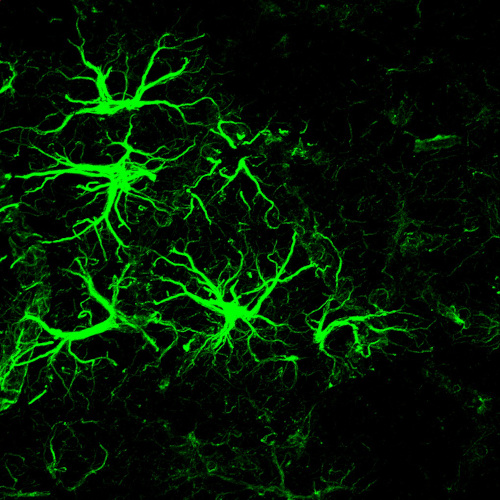
Intranasal administration of Bio-LTT1Ct peptide also promotes an increase in the expression of GFAP (green) in cortical astrocytes at 48 hours, replicating the activation of these cells following a stroke.
“It is clear that these results highlight prevention of excitotoxicity-induced TrkB-T1 processing as a promising new therapeutic strategy worth exploring. This applies not only to stroke but also to other forms of acute injury, such as spinal cord injury, where TrkB-T1 levels also increase and this receptor plays a central role in astrocyte proliferation and inflammation,” notes Dr. Serrano, an expert in the design of biomaterials for treatment of spinal cord injury.
This work was funded by “Agencia Estatal de Investigación” [PID2022-137710OB-I00 (MD-G) and PID2023-150170OB-I00 (MCS)]. Lola Ugalde-Triviño received a predoctoral fellowship from Ministerio de Ciencia, Innovación y Universidades (FPU22/01248, 2024-2028).
Cover image: Microglial activation, visualized using an antibody specific for the Iba1 protein (white), in mouse cerebral cortex 48 hours after intranasal administration of peptide Bio-LTT1Ct. Cell nuclei in the tissue were stained with DAPI (blue).
Article reference: Lola Ugalde-Triviño, María C. Serrano, and Margarita Díaz-Guerra. The intracellular region of truncated neurotrophin receptor TrkB-T1 is sufficient to promote brain glial reactivity, neuroinflammation and neurotoxicity. Mol. Biomed. 7, 247 (2026). https://rdcu.be/4QdaarHqyUna