- A study published in Redox Biology identifies the mechanism by which olanzapine promotes insulin resistance through signals originating in the hypothalamus. The findings point to PTP1B inhibition as a potential strategy to prevent these metabolic side effects
Olanzapine, one of the most widely used second-generation antipsychotics (SGAs) for the treatment of schizophrenia and other psychotic disorders, can alter metabolism when administered over prolonged periods. Its side effects include weight gain, dyslipidaemia (an imbalance in blood lipids, such as cholesterol and triglycerides), fatty liver disease and hyperglycaemia, all of which increase the risk of developing type 2 diabetes.
A team of researchers from the Instituto de Investigaciones Biomédicas Sols-Morreale (IIBM), CSIC-UAM, led by Ángela M. Valverde and belonging to the CIBER de Diabetes y Enfermedades Metabólicas Asociadas (CIBERDEM), has identified a mechanism by which olanzapine impairs the insulin response through signals originating in the hypothalamus. The study was carried out in collaboration with teams from CIBERDEM, the CIBER de Obesidad y Fisiopatología de la Nutrición (CIBEROBN), the Centro Nacional de Investigaciones Cardiovasculares (CNIC), the Centro Nacional de Investigaciones Oncológicas (CNIO), the CIMUS (Universidad de Santiago de Compostela) and the University of Massachusetts (USA).
Dr Ángela M. Valverde, principal investigator of the “Physiopathology and Molecular Mechanisms of Obesity and Comorbidities” research group at the IIBM and coordinator of the study, explains that the research “analyses the effects of olanzapine on insulin sensitivity in male mice treated with this SGA by intraperitoneal administration, focusing on how signals generated in the hypothalamus trigger impaired insulin responses in metabolically relevant tissues such as the liver and skeletal muscle.” The researcher highlights that “although intraperitoneally administered olanzapine protected against weight gain and hepatic steatosis, it still promoted insulin resistance.”
The hypothalamus plays a key role in the metabolic response
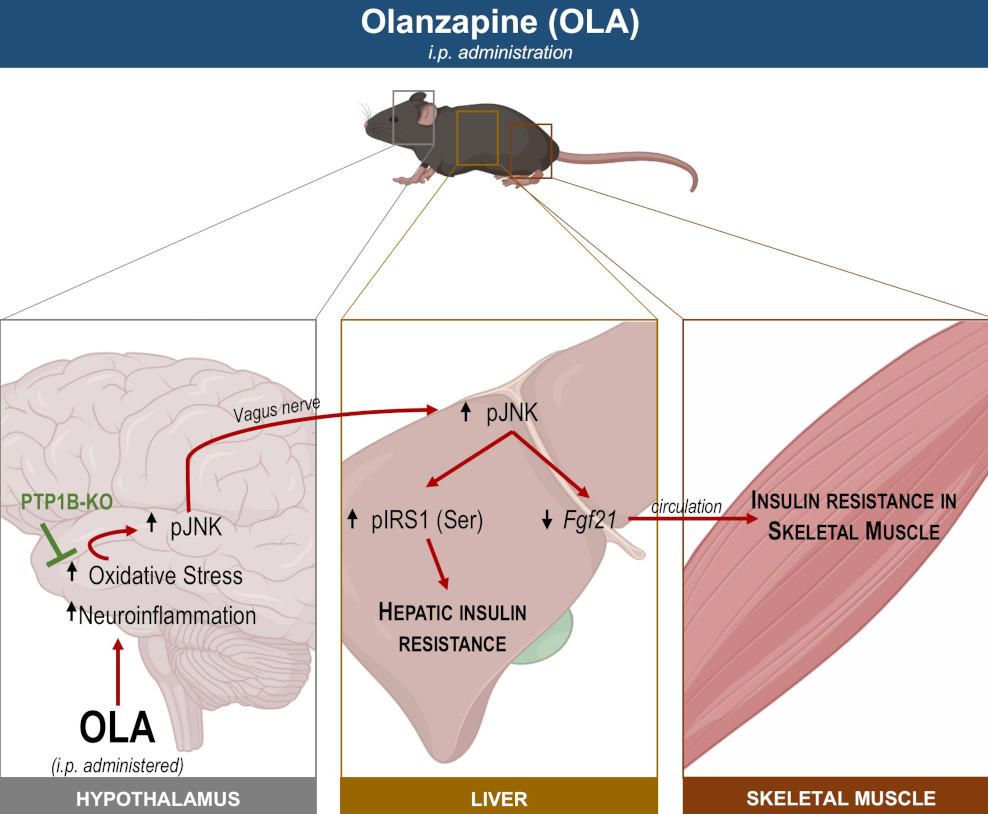
The research team demonstrated that intraperitoneal administration of olanzapine induces systemic insulin resistance, impairing the response of both the liver and skeletal muscle to this hormone. “This resistance is not due to a direct effect of the drug on the liver, but rather to inter-organ communication that depends on olanzapine acting in the hypothalamus through activation of the JNK1 kinase in this region of the central nervous system,” explains Vítor Ferreira, first author of the publication.
Patricia Rada, co-coordinator of the study, adds: “Surprisingly, activation of JNK1 in the hypothalamus triggers JNK1 activation in the liver through the vagus nerve, promoting insulin resistance in this organ and, in addition, reducing FGF21 production, thereby favouring insulin resistance in skeletal muscle.”
Using transgenic models and in vivo genetic approaches, the team identified a communication axis between the brain and peripheral tissues that helps explain how olanzapine disrupts glucose homeostasis. “Our findings reveal that olanzapine-mediated hypothalamic signalling drives insulin resistance in skeletal muscle secondary to liver dysfunction, and that this inter-organ dialogue disappears when central signalling is blocked,” says Ángela M. Valverde. This finding is particularly relevant because patients treated with second-generation antipsychotics have a three- to fourfold higher risk of developing type 2 diabetes.
PTP1B inhibition as a potential therapeutic strategy
The study also demonstrates that deficiency of protein tyrosine phosphatase 1B (PTP1B), a preclinical model previously described by the group as being resistant to olanzapine-induced weight gain and hepatic steatosis following oral treatment, also protects against insulin resistance induced by this SGA when administered intraperitoneally. The researchers highlight that this protection is due, at least in part, to reduced oxidative stress and neuroinflammation in the hypothalamus. “PTP1B inhibition acts directly on JNK1 in the hypothalamus, preventing the signalling cascade that leads to insulin resistance. This opens up new therapeutic opportunities to mitigate the metabolic side effects of olanzapine,” concludes Patricia Rada.
Reference: Ferreira V, Folgueira C, Hitos AB, Montes San-Lorenzo Á, Estévez-Salguero Á, Porteiro B, Davis RJ, López M, Sabio G, Rada P, Valverde ÁM. A hypothalamus-liver-skeletal muscle axis controlled by JNK1 and FGF21 mediates olanzapine-induced insulin resistance in an intraperitoneal treatment in male mice. Redox Biology. 2026;95:104286.doi:10.1016/j.redox.2026.104286.
Cover image: Hematoxylin and eosin (left) and Oil Red O (right) staining of a liver section from a mouse treated with 10 mg/kg olanzapine.