- The research, led by Celia López and Teresa Iglesias, focuses on the complex forms SPG11 and SPG15 of this rare neurodegenerative disease
- The awarded project combines molecular and translational approaches with the use of patient-derived cellular models to advance the development of precision therapies
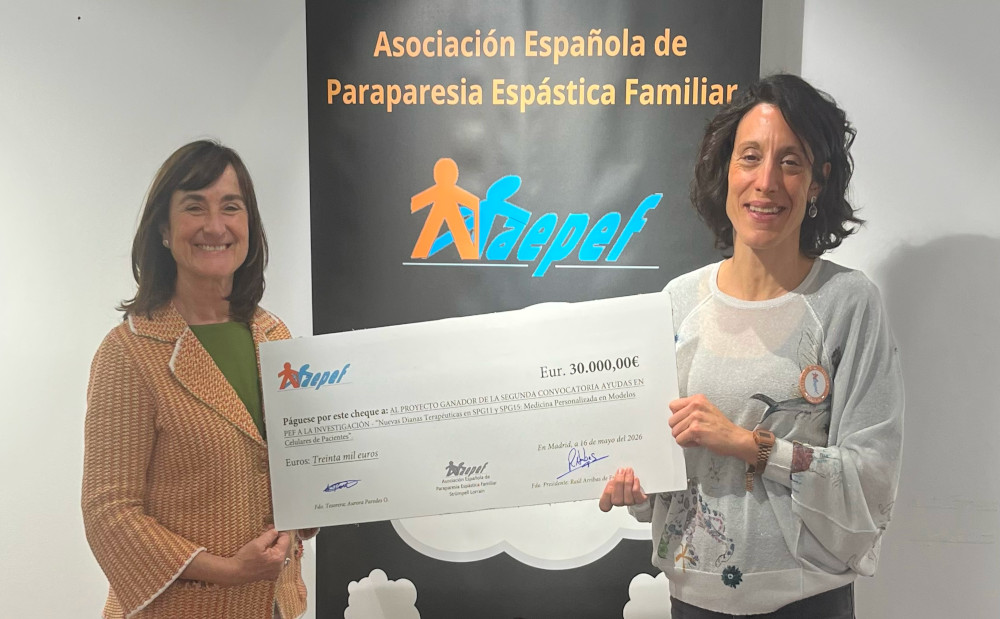
The project “New Therapeutic Targets in SPG11 and SPG15: Personalized Medicine in Patient-Derived Cellular Models,” led by Dr. Celia López Menéndez and Dr. Teresa Iglesias Vacas, researchers at the Instituto de Investigaciones Biomédicas Sols-Morreale (IIBM), CSIC-UAM, has been selected as the winning project of the II Call for Research Grants from the Asociación de Paraparesia Espástica Familiar (AEPEF).
This year’s call, focused on the SPG11 subtype—one of the most common complex forms of hereditary spastic paraplegia (HSP), caused by alterations in the gene of the same name—recognizes innovative proposals with the potential to improve the understanding and clinical management of this rare disease. The award ceremony took place on May 16 at Fundación ONCE in Madrid, in an event attended by members of the association, patients and their families, as well as researchers from the group led by Teresa Iglesias, “New Targets in Neurodegeneration and Cancer,” at IIBM. The event was also attended by the institute’s director, Dr. Pilar López Larrubia.
Precision medicine research for rare diseases
The awarded project proposes an approach that integrates molecular and translational strategies, together with the use of patient-derived cellular models. It also includes a comparative analysis of the SPG11 and SPG15 subtypes (two genetic forms of the disease with partially shared molecular mechanisms), which will enable the identification of both common and specific biological pathways.
This approach aims to advance the development of precision medicine strategies to improve diagnosis and clinical management, as well as to open new avenues toward effective therapies that can enhance patients’ quality of life.
This work builds on the group’s track record of more than 25 years studying molecular mechanisms involved in nervous system diseases, as well as its research on the KIDINS220 gene and its role in SINO syndrome (Spastic Paraplegia, Intellectual Disability, Nystagmus and Obesity), another form of hereditary spastic paraplegia with clinical features partially overlapping with the SPG11 subtype.
A rare, underdiagnosed disease with no curative treatment
Hereditary (or familial) spastic paraplegias (HSP) are a group of rare, inherited neurodegenerative disorders characterized by progressive degeneration of motor neurons, leading to weakness and spasticity in the lower limbs. In their complex forms, motor symptoms are accompanied by additional neurological alterations that often appear in childhood or adolescence.
The high clinical and genetic variability of these disorders makes diagnosis particularly challenging. In many cases, a confirmed diagnosis may take between seven and ten years, as it depends on advanced genetic testing that is not equally accessible across regions. In addition, data from the Spanish Society of Neurology indicate that nearly 48% of patients in Spain still lack a definitive genetic diagnosis. This situation not only complicates estimating the true number of affected individuals—more than 40,000 in Spain—but also places a significant emotional burden on patients and their families, marked by uncertainty and the lack of effective therapeutic options.
Among the complex forms, the SPG11 subtype accounts for approximately 19% to 31% of diagnosed cases. It is caused by mutations in the SPG11 gene and is associated with a broad spectrum of neurological symptoms—including cognitive impairment, parkinsonism, peripheral neuropathy, and dementia—that significantly affect patients’ autonomy.
At the cellular level, these genetic alterations impair essential processes for proper neuronal function, such as endolysosomal trafficking and autophagy. Understanding these mechanisms is key to identifying new therapeutic targets, both shared across different subtypes and specific to each, with potential clinical application. In this context, the project led by IIBM researchers will contribute to advancing the understanding of these processes and to opening new avenues toward potential therapeutic strategies, with the ultimate goal of improving the quality of life of patients and their families.