Throughout June, the Instituto de Investigaciones Biomédicas Sols-Morreale (IIBM), CSIC-UAM welcomed eleven students as part of the Científic@s en Prácticas and Spanish Biology Olympiad programs. During these research placements, the participants spent one week integrated into different research groups at the Institute, gaining first-hand experience of how biomedical research is carried out and discovering or reinforcing their scientific vocation.
Científic@s en Prácticas: experiencing science from the inside
The Científic@s en Prácticas programme, promoted by the CSIC under the coordination of Jesús Rey and the Asociación Española para el Avance de la Ciencia (AEAC), offers students in the third year of compulsory secondary education (3º ESO) and the Curricular Diversification Programme (PDC) from disadvantaged backgrounds the opportunity to experience first-hand the work carried out in a research institute.
The programme takes place throughout the academic year in three stages. During the first stage, IIBM researchers participating in this year's Científic@s en Prácticas programme visit the participating secondary schools to present their research lines and bring science closer to the classroom. In this edition, María Monsalve and Alain de Solis gave talks at IES Miguel Catalán and IES Joaquín Rodrigo, respectively.
Later in the programme, two visits were organised on different days so that groups of third-year secondary school students could tour the IIBM facilities and discover what our daily work involves. One of these scientific tours was coordinated by María Monsalve's research group, which welcomed students from IES Miguel Delibes. The other was organised by Belén Peral, Juan Manuel Zapata and Alain de Solis, who guided students from IES Tirso de Molina through the Institute. After the visit, the teacher accompanying the latter group expressed her appreciation with words that reflect the impact of the experience: "The students felt very comfortable, they were truly impressed by the Institute, and their overall impressions were extremely positive. We know that organising visits like these requires the involvement of many people and disrupts their daily work, so thank you very, very much."
The final stage of the programme took place from 15 to 19 June, when eight students from IES Antonio Domínguez Ortiz, IES Santa Eugenia, IES San Cristóbal de los Ángeles, IES Miguel Catalán and IES Palomeras-Vallecas carried out one-week research placements in the laboratories led by Juan M. Zapata, Ángela Martínez-Valverde, María Monsalve and Alain de Solis. Manuel Delgado, Nora Llambias, Emran Ghailan, Yuliia Dokhniak, Itzíar Rocha, Sara Rebolledo, Carlos Inti Alconcé and Viviana Rechitean had the opportunity to experience first-hand the daily work of researchers, take part in a range of laboratory activities and experience biomedical research from the inside.
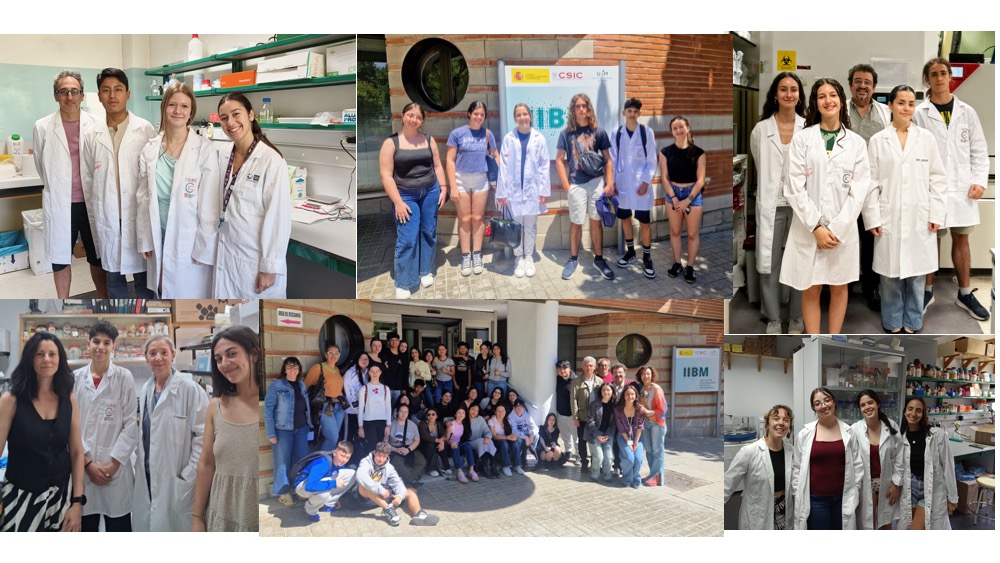
During that week, the IIBM also welcomed three representatives from Fundación Pfizer, which has supported this program for the past three years, accompanied by Jesús Rey, the program coordinator.
Spanish Biology Olympiad: encouraging scientific talent
From 29 June to 3 July, the IIBM also welcomed three students recognised in the XXI Spanish Biology Olympiad, held this year in Santander. These placements enable the award-winning students to spend one week in leading research groups and gain first-hand experience of biomedical research.
Santiago Requero, from Colegio Santa Catalina de Sena (Madrid) and gold medallist; Antonio Monge, from Colegio Salesiano María Auxiliadora (Mérida), also a gold medallist; and Alejandra Luparelli, from Colegio de Fomento Miravalles-El Redín (Pamplona), finalist in the XXI Spanish Biology Olympiad, carried out their placements in the Group of Pathophysiology and Molecular Mechanisms of Obesity and Comorbidities, led by Ángela Martínez-Valverde; the Nanoimmunology and T Lymphocytes Group, headed by Manuel Izquierdo; and the Immunity, Immunopathology and Emerging Therapies Group, led by Juan M. Zapata, respectively.
Hosting these three students was a privilege for the Institute, which had the opportunity to share a week with young people whose enthusiasm and talent point towards a brilliant scientific future. In addition, Santiago Requero and Antonio Monge are members of the Spanish team that will represent the country at the International Biology Olympiad, to be held next August in Lithuania.
The experience also left a lasting impression on the students themselves. As Alejandra Luparelli explains: "I have always known that I wanted to become a researcher, but it is difficult to understand what this job is really like until you experience it. After spending time with researchers and seeing how they work, I can say that this experience has reinforced my decision about both my university studies and my future career."
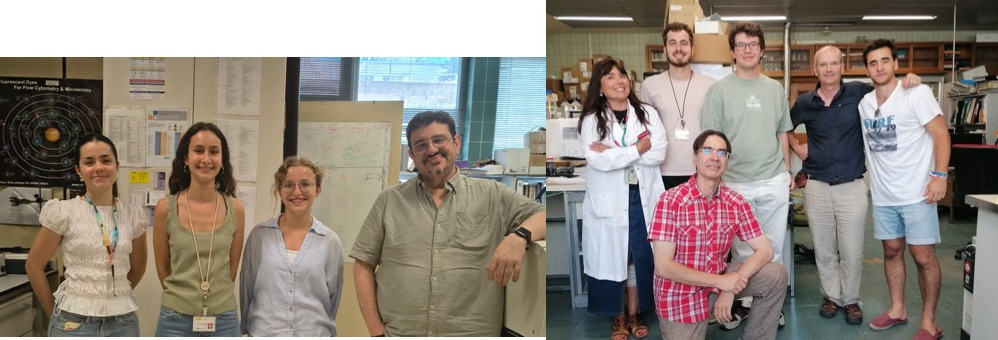
The IIBM would like to thank all the researchers whose commitment made these initiatives possible. This year's edition involved the research groups led by Juan Manuel Zapata, Ángela Martínez-Valverde, María Monsalve, Manuel Izquierdo and Alain de Solis. We would especially like to acknowledge the contribution of Celia González, Irene Anubla de la Cruz, Elena Carceller, Elena del Fresno, Ana B. Hitos, Silvia Calero, Patricia Rada, Angela Montes, Irma García Clara Bernet, Leticia Selinger, Laura Doblado, Javier Ruiz and Ana J. Candel.
Through initiatives such as Científic@s en Prácticas and the Spanish Biology Olympiad program, the IIBM reaffirms its commitment to fostering scientific vocations and training the next generation of researchers by bringing biomedical research closer to young students and offering them the opportunity to discover science from inside its laboratories.